
Voting Rights Post Prison: Racial Disparities and the Modern Felon Vote in Florida
By: Jade Vazquez
Abstract
Florida has a history of abusing felony disenfranchisement laws which affects a substantial portion of its population. These laws are geared to restrict low-income racial minorities. While the 14th Amendment allows states to disenfranchise individuals for “participation in rebellion, or other crime” (U.S. Const. amend. XIV, §2), Florida’s policies are the most restrictive in the entire country and have gone further by imposing both legal and financial barriers to restoration. This paper inspects the historical importance of Florida’s disenfranchisement laws, analyzes the impact of Amendment 4 (2018) and how subsequent legislation (SB 7066) further restricted access to voting rights. It will walk through Jones v. DeSantis (2020) and will discuss hurdles that complicate the restoration process and evaluate potential policy alternatives. Finally, this paper argues that Florida’s current system undermines equal protection laws, violates the 24th Amendment and in doing so, creates restrictive barriers to democratic participation. Reform in Florida is necessary to align voting rights with constitutional and equitable democratic principles.
Voting Rights Post Prison: Racial Disparities and the Modern Felon Vote in Florida
In the United States, felony disenfranchisement (taking a felon’s right to vote away due to a crime they were found guilty of committing) has been upheld and debated for over 160 years. Florida has been at the heart of that debate because of its extremely restrictive laws. Currently, 1 in 10 Floridians are affected by these laws with Black and Latinx low-income citizens being discriminated against the most. (Uggen et al., 2024). While the 14th Amendment allows disenfranchisement for criminal convictions, Florida’s restrictive laws continue to impose repressive barriers to accessing voting rights. The state needs to reevaluate its current process to restoring rights because its current process raises serious ethical and legal concerns about key voting rights protections.
During the post-Reconstruction era, Southern states looked for loopholes to deprive the vote of newly enfranchised people of color citizens. Although these states were required to comply with the new extensions of civil and political rights, they developed new criminal statutes which achieved similar suppressive effects. In Florida, lawmakers expanded the category of disenfranchising offenses and were disproportionately enforced against African Americans. By defining a wide range of behaviors as felonies, the state effectively removed thousands of Black residents from the electorate throughout the late nineteenth and early twentieth centuries (Manza & Uggen, 2006). Over time, these policies became deeply embedded in Florida’s political structure and shaped long term patterns of exclusion that still are in effect today.
Felony disenfranchisement in itself was affirmed by the Supreme Court in Richardson v. Ramirez (418 U.S. 24, 1974). In that case, the Court interpreted the Fourteenth Amendment as allowing states the authority to restrict voting rights on the basis of criminal convictions. However, it did not give states unlimited discretion. SCOTUS later clarified in Hunter v. Underwood (471 U.S. 222, 1985) that disenfranchisement laws that had racially discriminatory intent violate the Equal Protection Clause. This decision led some states to change their voting rights laws but not Florida.
In November 2018, Florida voters took to the ballot and passed Amendment 4. This amendment was seen as a landmark law as it aimed to restore voting rights to individuals with felony convictions upon completion of their sentence (including parole and probation). The amendment still excluded those convicted of murder or sexual offenses as these cases still required approval from the Governor. Initially, Amendment 4 restored voting rights to an estimated 1.4 million Floridians, which was a significant expansion of the electorate. In the first few months after taking effect, more than 44% of previously disenfranchised citizens who registered to vote identified as Black, even though Black voters overall constitute about 13% of Florida’s registered electorate (Morris, 2019). This amendment aligned the state’s voting rights with laws already in place in other traditionally conservative “red” states such as Texas, Georgia, and Louisiana. While this was celebrated as a major step toward restoring democratic participation, Amendment 4’s impact was soon diminished by legislative action.
In 2019, the Florida Legislature passed SB 7066, which amended Amendment 4 to include that only upon the full payment of all fines, court fees and restitution could a person get their vote back. This financial requirement created substantial barriers for low-income and minority citizens. After the law passed, anyone hoping to regain their voting rights had to check with the courts and county officials to prove they’d paid for everything associated with their charge. For many, this meant sorting through confusing records and trying to figure out rules that weren’t always straightforward since they also didn't have the money to hire a lawyer. This led to
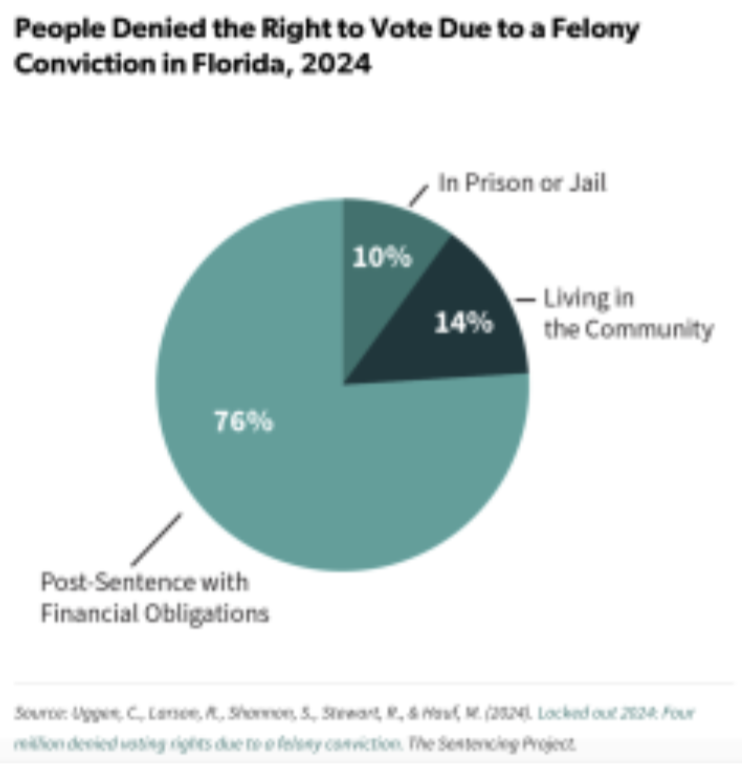
many newly freed citizens having to handle complicated legal procedures on their own while having no knowledge of court systems and requirements. In the chart to the left, The Sentencing Project (Uggen et al., 2024) found that 76% of people denied the right to vote was due to the inability to pay for fees and fines. By doing this, the Florida Legislature limited the amendment’s reach. Additionally, the financial requirement that was set impacted Black and Latinx Floridians the most. Scholars and advocates against SB 7066 argue that by hinging voting rights on financial obligations, the state created a modern poll tax, which potentially violates the Equal Protection Clause. Although the Fourteenth Amendment guarantees equal protection under the law, in practice, Florida’s financial requirements create a de facto wealth-based barrier to the franchise. To illustrate, two people convicted of similar crimes can experience different access to voting rights simply based on their economic standing which undermines the Equal Protections Clause.
Jones v. DeSantis (462 F. Supp. 3d 1236, 2020) aimed to challenge these new requirements stating both constitutional and ethical concerns. The plaintiff had once been incarcerated and sued the state arguing that making people pay fines and fees in order to vote again was unfair and violated their constitutional rights. The case also discussed the disproportionate impact on low-income communities this new bill had. U.S. District Judge Robert Hinkle characterized Florida’s new requirement that people pay court-imposed fines and fees before regaining the right to vote as a “pay-to-vote” scheme. He concluded that by the state conditioning the franchise on unpaid legal financial obligations (which would be revenue that went to the state), SB 7066 was unconstitutional due to a ban on poll tax under the Twenty-Fourth Amendment. Judge Hinkle put in place a temporary injunction and ordered that Florida cannot deny voting rights based solely on inability to pay fines, fees, and restitution. He further ordered that Florida must create a system to determine who is ineligible to pay and prohibited criminal prosecution of individuals who registered based on the state’s inability to verify their eligibility. The State appealed to the 11th Circuit Court of Appeals and after hearing the case reversed and vacated the original injunction. The court (in a 5-3 en banc decision) rejected claims that the law violated the Equal Protection Clause or that there was an unconstitutional poll tax. By doing this, the Eleventh Circuit agreed that states have broad discretion to establish the conditions for restoring voting rights. What stood out were the dissents which reflected ongoing judicial disagreement over whether tying the franchise to financial obligations creates an unfair barrier for low-income citizens. As a result, Florida was permitted to continue enforcing SB 7066, effectively maintaining the “pay-to-vote” structure that disproportionately affects returning citizens who cannot easily satisfy the state’s financial requirements. The majority failed to understand that Florida’s disenfranchisement system was built on efforts to exclude minority citizens from the electorate. This goes to show the inequities in the electoral system that still exist in today's world.
One potential reform to current policy is extending voting rights to people on parole, except for those convicted of murder or sexual offenses. Inmates currently in prison would remain ineligible to vote. A second policy reform is restitution be the only monetary-related barrier combined with a simplified verification process to reduce unnecessary administrative hurdles. Additionally, policymakers could implement measures to make the restoration process more transparent and accessible by offering in prison seminars on how to get your vote back when an inmate is released ensuring that eligible individuals can fully exercise their right to vote. Furthermore, allowing rehabilitating parole officers to assist with the reenfranchisement process could help returning citizens navigate the system more effectively. These proposals would place Florida more on par with states like California, New York, and Colorado for incarceration status but slightly more conservative due to the restitution requirement. These proposals would promote social equity, uphold constitutional principles and give broader access to civic participation.
Overall, Florida’s current process for restoring voting rights has historical connections to loopholes used to oppress marginalized communities. Although Amendment 4 marked a significant step toward expanding the franchise, subsequent legislation introduced complex administrative requirements have substantially limited its impact. Financial obligations and procedural hurdles continue to burden returning citizens particularly affecting low-income and minority populations which undermines both equal protection and the 24th Amendment. Voting is a fundamental part of citizenship and no one should be blocked from participating because they owe money to the state. Ensuring that all eligible formerly incarcerated Floridians can fully exercise their constitutional right to vote will require comprehensive reforms, including the automatic restoration of voting rights upon release, to encourage participation in the democratic process. If individuals with felony convictions are legally allowed to run for and hold public office, it raises questions about whether all eligible citizens with felony convictions should have the right to vote, regardless of income or race.
References
U.S. Const. amend. XIV, §2
Hunter v. Underwood, 471 U.S. 222 (1985).
Jones v. DeSantis, 462 F. Supp. 3d 1236 (N.D. Fla. 2020).
Manza, J., & Uggen, C. (2006). Locked out: Felon disenfranchisement and American democracy. Oxford University Press.
https://www.nypl.org/sites/default/files/manza_uggen_-_chapter_2.pdf
Morris, K. (2019, May 9). Thwarting Amendment 4. Brennan Center for Justice. https://www.brennancenter.org/our-work/research-reports/thwarting-amendment-4
Richardson v. Ramirez, 418 U.S. 24 (1974).
Uggen, C., Larson, R., Shannon, S., Stewart, R., & Hauf, M. (2024). Locked out 2024: Four million denied voting rights due to a felony conviction. The Sentencing Project. https://www.sentencingproject.org/reports/locked-out-2024-four-million-denied-voting-rights-due-to-a-felony-conviction/
